Glasgow
Glasgow is one of those places that bears its ups-and-downs and stoically moves on to the next economic opportunity when required. In this way, it has grown from being a ‘green glen’, or Glas-gu/Glas-cau, with one church, established by St Mungo, in the 6th century, to the UK’s third largest city today. It straddles the River Clyde 20 miles from Scotland’s Atlantic coast to the west and 45 miles from Edinburgh to the east.
It acquired a Bishop in 1115 along with its first cathedral in 1136. Its growing importance was acknowledged 300 years later by the addition of an Archbishop and a University. Glasgow took on all available trades and when the Clyde began to be dredged in the 1770s, it was able to become a major trading centre. This also facilitated the expansion of shipbuilding yards and this became Glasgow’s big industry, beside textiles, coal-mining, steelworks and chemical manufacture. These are now gone but modern technological businesses have taken their place.
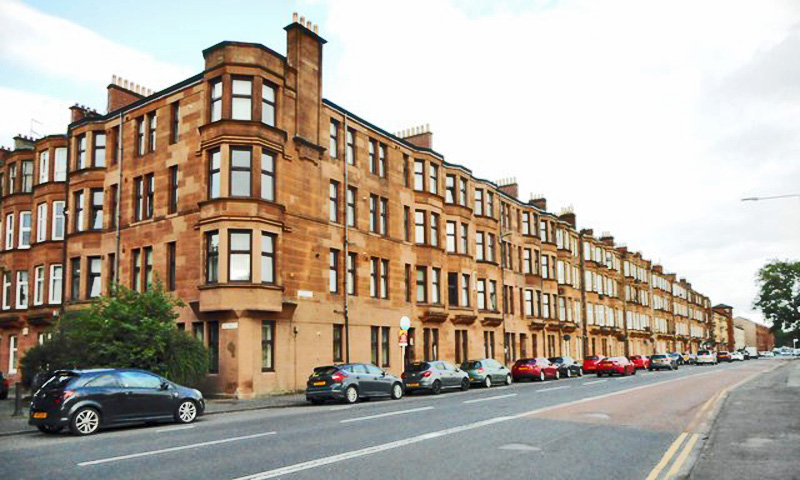
Long blocks of 4= and 5-storey sandstone tenements were built around 1840-1920 for the workers and middle-classes alike. These provided high-density housing in a space-saving grid pattern, all of which lent itself to close community relationships and 73% of Glaswegians still live in tenements today.
(Image: Richard Sutcliffe at geograph.org.uk / CC BY-SA 2.0)