
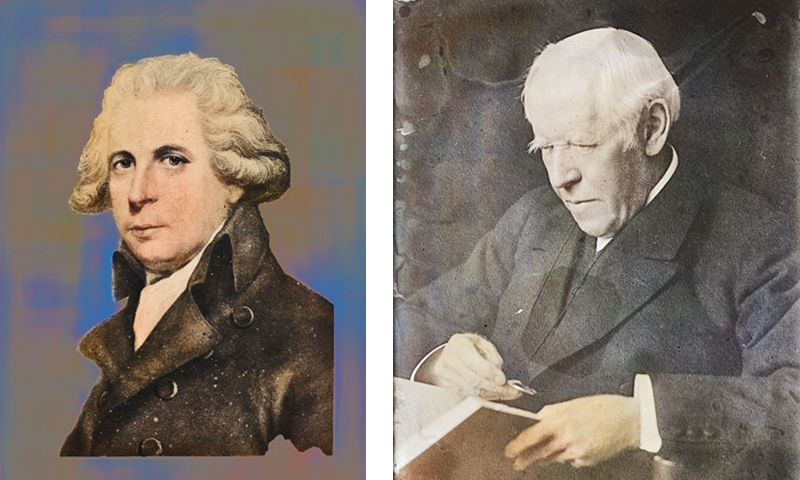
Malapropisms and Spoonerisms
Richard Brinsley Sheridan (1751-1816) had Irish lineage and was an MP at Westminster for 32 years, lending him ample experience of the clever, comedic and nonsensical use of the English language. His own wit and articulacy are evident in his writings, which include his first play, ‘The Rivals’ (1775).
One of the characters, Mrs Malaprop (deriving from the French mal-à-propos, meaning inappropriate), likes long words but gets them confused, e.g. “… but he can tell you the perpendiculars” – she means ‘particulars’, and “… to illiterate him quite from your memory” – she means ‘obliterate’.
Mixing up similar-sounding words is something people normally avoid by substituting simpler vocabulary if they are not sure, but when it is done in this forthright manner, it is called a malapropism in honour of Sheridan’s comic exposure of the phenomenon.
Another playful word-twist was pinpointed when William Archibald Spooner (1844-1930) of London, teaching at Oxford University, was said to absent-mindedly switch the first letters or syllables of adjacent words, e.g. “… the weight of rages…” instead of “… the rate of wages…” or even the complete words, e.g. saying “Dr. Friend’s child” instead of “Dr Childe’s friend” . Spooner, once aware of this quirk, apparently began to speak more slowly in an effort to self-edit.
(Images LtoR: Sheridan at picryl.com / Public domain, Spooner at Wikimedia Commons / Public domain)