
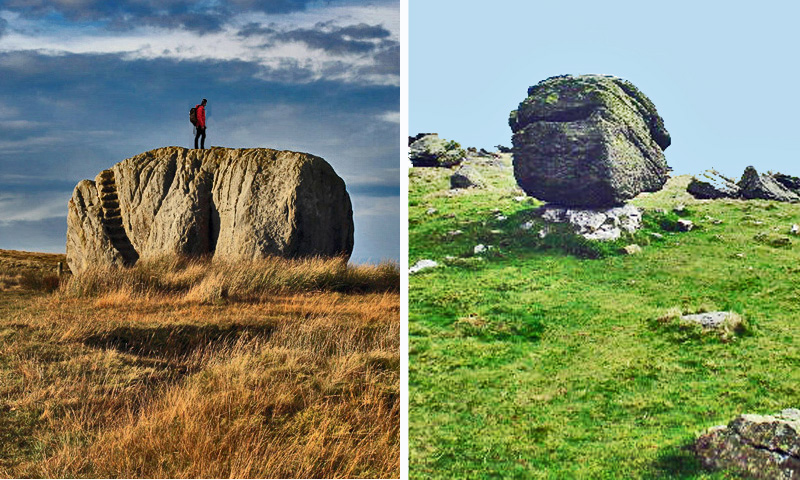
Glacial Erratics
We are told that the last Ice Age (the Younger Dryas) ended around 12,000 years ago, with the massive sheets of ice that were covering the land suddenly retreating. This movement was of sufficient force and strength that it carried with it rocks and boulders of all sizes.
As the ice broke up or melted, these were left behind, thereby creating the strange phenomenon of glacial erratics of Silurian sandstone and slate sitting on more easily eroded limestone ground miles away from their origin. There are hundreds of these in the UK, with North Yorkshire being a major recipient. However, recent research has suggested that the boulders might be up to 17,900 years old. An alternative explanation might therefore exist for them travelling to a new location.
One example of an erratic is Yorkshire’s Great Stone of Fourstones, which displays its formerly horizontal strata at an upright angle. The stone is 18ft. high and has had 14 steps carved into one side. Naturally, stories have grown up around the huge boulders, variously involving giants, great floods and the Devil. The Great Stone itself has a grid reference of SD669663, by sheer coincidence.
(Images LtoR: the Great Stone by Chris Heaton, other Yorkshire erratics by Steve Partridge, both at geograph.org.uk / CC BY-SA 2.0)