Children’s singing and chanting games
Peter Opie (1918-82) and his wife Iona (1923-2017) were pioneers of research into and cataloguing of children’s nursery rhymes and playground singing games in the UK. Their work spanned the entire second half of the 1900s and uncovered a rich treasury of oral tradition in the world of young learners of English. Their numerous books form the basis of our recognition of the correlation between children’s singing and chanting games and language acquisition.
Children learn language by listening and copying, but units of ordinary speech streams can be difficult to pick out. By setting them into rhythms and melodies, along with the invaluable benefits of repetition by singing these songs several or many times, children can more easily ascertain particular words, grammar and meaning. Old and new games , most involving actions such as skipping, clapping or joining hands, continue to be used by parents, teachers and youth leaders today.
One example is this song, in which all the body parts mentioned are patted with both hands as they are sung:-
Head, shoulders, knees and toes, knees and toes
Head, shoulders, knees and toes, knees and toes
And eyes and ears and mouth and nose
Head, shoulders, knees and toes, knees and toes.
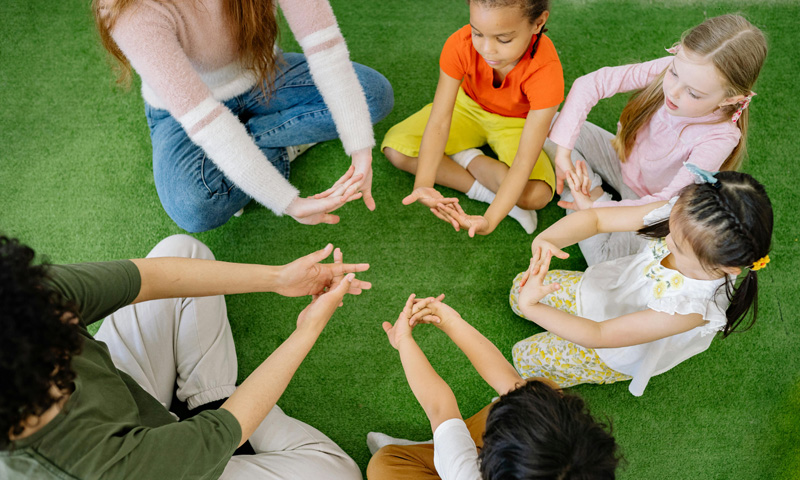
(Image of chanting and finger game: Krukau at pexels.com / CC0)